


Show up at a doctor's office with a cough, and your account of the problem is only the beginning. A cough could be a lingering cold, bronchitis, COVID or the first sign of something in the lungs worth catching early. The doctor will listen to your chest, check your blood oxygen saturation level, and if necessary order a chest X-ray. Walk in with chest pain and a cardiologist connects you to an EKG (electrocardiogram) and watches your heart's electrical activity draw itself across a screen. Modern medicine runs on objective measurement. Yet psychiatry remains a striking exception.
PTSD, one of the most widespread and disabling mental health conditions, like all psychiatric conditions, is diagnosed essentially the same as it was a century ago. A clinician sits across from a patient and listens to the person describe their feelings.
Think about how strange that is. We ask patients to report a malfunction in the very organ they must use to describe it. In most of medicine, the patient interview is where the investigation starts, not where it ends. We listen to what the patient says and then look for evidence we can independently and objectively observe and measure.
The problem isn’t only how we diagnose. For much of the past century, mental health treatment has been dominated by two basic approaches: medication and psychotherapy. Both have helped millions. But millions of others cycle through one drug after another or spend years in therapy without finding lasting relief. What if there were another way?
The brain is roughly 86 billion neurons, a comparable number of non-neuronal support cells, and hundreds of trillions of connections among them, all communicating through electrical and chemical signals. It is the most complex system known to science—and the thing making sense of this sentence right now. It is also, unmistakably, a physical organ. Its structure, chemistry, blood flow, oxygenation, metabolism, and electrical activity can all be measured through various imaging and diagnostic technologies. But that same complexity is exactly why psychiatry has lagged. A heart pumps blood the same way in nearly everyone. A brain is continuously rewired by everything its owner learns and lives through, so an enormous amount of activity, learning and individual variation sits behind any two people who carry the same diagnosis. Measuring the brain usefully means measuring it in individual patient, not in the average patient. That is why mental health care has been slower than other branches of medicine to bring biological signals into everyday treatment at the level of the individual.
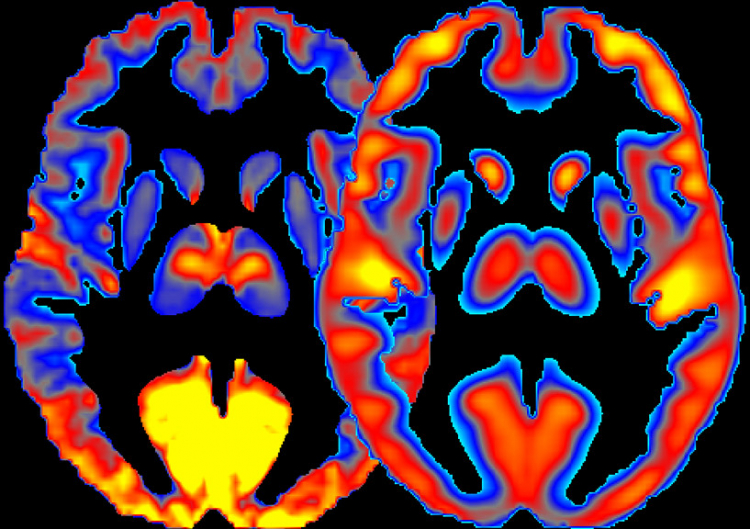
We now have ways to do that. Just as an EKG detects electrical activity generated by the heart, an EEG can detect electrical signals generated by the brain. It follows that activity millisecond by millisecond, but it listens from the scalp, so it cannot say with confidence how deep in the brain a signal arose. Functional MRI, or fMRI, measures changes in blood oxygenation and flow associated with brain activity, and it can see structures buried deep in the brain — but the blood-flow response it depends on unfolds over seconds, and the scanner is expensive and immobile. Neither one alone is enough.
Researchers have recorded both at the same time and applied machine learning models to register the data from fMRI to EEG. This is the fMRI-Informed biomarker. For PTSD, this approach resulted in an EEG biomarker informed by fMRI data from the amygdala and the wider circuit it anchors, the network involved in detecting threats and regulating emotional responses. The target is shared across patients with the disorder; what differs from patient to patient is how they learn to move it. During treatment, a patient wears an EEG device that tracks this amygdala-related signal and translates it into real-time feedback through an interactive computer simulation. By experimenting with different thoughts and mental strategies, the patient gradually learns which personalized strategies change the signal and hence their emotional state.
That process matters because what the patient walks out with is a skill, not a dose. Repeated practice changes the brain’s connections — neuroscientists call this neuroplasticity, and it is the biological machinery behind learning a language, mastering an instrument, or relearning how to walk after a stroke. While plasticity is the presumed mechanism, what the patient gains is more concrete and useful: the strategy learned in the clinic can be recalled in daily life, unaided, without the device. Researchers call this a “just-in-time adaptive intervention.” Training happens in a controlled setting; the learned regulation is then applied in real life, in the minutes after an actual stressor, at exactly the moment symptoms would otherwise escalate and the patient is furthest from any treatment facility.
Self-neuromodulation applies that learning to treatment. Session after session, patients receive information generated by their own brain activity and practice influencing the signal. They are not merely passengers in the process; they are learning a form of self-regulation through repetition. It is the brain, in effect, learning to correct its own course. For someone with PTSD—say, a combat veteran whose nervous system has spent years reacting as though danger is always near—that participation can be especially meaningful. Trauma often leaves people feeling that their own reactions are beyond their control. This approach gives them a way to practice influencing those reactions and, with them, begin recovering a sense of agency.
The evidence is encouraging. Prism is a new category of therapeutic device: personalized self-neuromodulation, and is FDA-cleared as an adjunct to standard care for PTSD. In a prospective, multicenter, multinational study, two-thirds of participants experienced a clinically meaningful reduction in symptoms three months after treatment. Their average improvement was more than twice the threshold clinicians use to define a meaningful response.
Outcomes in community practice, where patients carry more comorbidity than clinical trial populations do, have been consistent with the trials: in a case series of 28 consecutive patients treated in a community psychiatry clinic, 90 percent of those who completed treatment had a clinically significant reduction in symptoms. Reported side effects, including headache and fatigue, were generally mild and resolved on their own.
None of this replaces the psychiatrist, the therapist, or the prescription pad. It adds an instrument we have been missing. A century from now, we suspect people will look back at an era when mental health care relied so heavily on what patients could describe, while making so little use of what the brain could reveal in real time, and wonder why we thought that was enough.
The brain is a physical organ like any other. It is time we start treating it like one.
Oded Kraft is the co-founder and CEO of GrayMatters Health, maker of Prism, a platform powered by digital biomarkers with protocols for PTSD and depression. Aron Tendler is the Chief Medical Officer at GrayMatters Health.
