


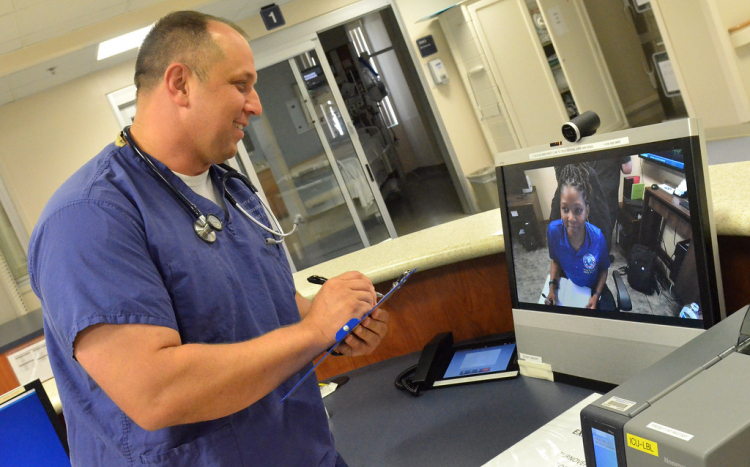
Visiting a doctor is easier when the appointment can take place from home. Since the COVID-19 pandemic, telehealth has become a common option for many patients. For routine visits, it can lower costs, expand access, and bring badly needed competition to healthcare markets. Yet its biggest obstacles are not technological. They are political. Federal policymakers continue to treat it as a temporary pandemic-era exception, while states preserve licensing and regulatory barriers that protect established providers from competition. Congress should make telehealth a permanent part of Medicare, and states should remove restrictions that prevent patients from seeking remote care.
Telehealth gives patients an opportunity to choose providers based on price, quality, and availability rather than physical location. Yet Congress has not permanently adopted the Medicare telehealth flexibilities created during the pandemic. These flexibilities are temporary rules that allow Medicare patients to receive more types of care remotely. Instead of making those rules permanent, Congress has repeatedly extended them for limited periods.
The current extension through 2027 preserves access for now, but it leaves providers and technology companies uncertain about which rules will apply afterward. That uncertainty discourages investment in telehealth systems and developing new ways to deliver remote care. Congress should stop governing telehealth through last-minute extensions and make it a permanent part of Medicare.
Medicare policy is not the only barrier limiting telehealth. State licensing requirements keep healthcare markets local even when care can be delivered remotely. A physician or other licensed medical professional must be authorized to practice in the state where the patient is located. Requiring providers to obtain, pay for, and maintain licenses in numerous states reduces the number of potential telehealth providers and raises administrative costs.
Interstate licensing agreements can reduce some of these barriers, making it easier to practice between participating states. Although that is an improvement, it falls short of nationwide license portability. States have another option: universal license recognition—or automatic reciprocity. Under this policy, a state recognizes the license of a qualified provider who is already licensed and in good standing in another state, without requiring the provider to obtain another full license.
For example, a state could allow a physician licensed in New York to treat its residents even though New York does not participate in the physician compact. The receiving state could still require the physician to register, follow its medical laws, and accept the authority of its licensing board. But it would not force the physician to repeat the entire licensing process simply because the patient lives across a state line.
Greater interstate access would increase the number of providers competing for patients, shorten appointment wait times, expand access to specialists, and pressure providers to offer better service at lower prices. It would also allow patients to maintain relationships with trusted providers after moving or while traveling. Regulations should protect patients from negligence and misconduct, not shield local providers from out-of-state competition.
Telehealth offers its greatest potential benefits in rural communities, where access to care is often scarce. Rural areas frequently have fewer primary-care providers, fewer specialists, and longer travel times to medical facilities. For many rural patients, the realistic alternative to telehealth is not a convenient in-person appointment. It is delayed treatment or no treatment at all.
Remote care can connect rural patients with primary-care providers, specialists, and chronic-care management that may not be available locally. It also reduces transportation expenses, missed work, and childcare costs. These savings can make healthcare substantially more accessible for patients with limited time or resources. Restrictions on telehealth therefore impose especially high costs on rural communities.
Unfortunately, some states that permit telehealth still require an initial or periodic in-person examination, particularly before certain medicines may be prescribed remotely. These rules can force patients to travel for an appointment with the primary purpose being to satisfying a legal formality, even when the provider has determined that an in-person examination is not medically necessary.
Expanding telehealth does not require a complicated federal program. Congress should make Medicare’s temporary telehealth rules permanent so providers can expand remote services without fearing that reimbursement will disappear after the next legislative deadline.
States should also adopt universal license recognition for qualified medical professionals licensed and in good standing elsewhere. That would allow providers in nonparticipating states to treat patients across state lines even when their home-state legislatures decline to join a compact. Finally, states should remove blanket requirements for in-person visits before beginning telehealth treatment or prescribing medication when an examination is not clinically necessary.
Telehealth rules should be based on patient safety, treatment outcomes, and the medical risks of a particular service. Not based on the physical location of the provider. Telehealth can give patients more choices, particularly in areas with few providers, and introduce more competition into healthcare markets. The central question is no longer whether remote care works. It is whether policymakers will stop treating it as a temporary emergency measure and allow a national telehealth market to develop.
Justin Leventhal is a senior policy analyst for the American Consumer Institute, a nonprofit education and research organization. For more information about the Institute, visit www.TheAmericanConsumer.Org or follow us on X @ConsumerPal.
